Passion & Compulsion
On being moved to action


My article on aesthetics introduced a complication (in contrast to Classical Stoic theory) that warrants untangling. And in doing so it’ll also be necessary to address the Classical notion of “passion” that the ancient Stoics surmised compelled us to act for wrong reasons.
Because the way the ancient Stoics conceptualized one ought to act, was to perfect one’s reason so that one would always be able to act virtuously. However, what was virtuous in any given moment was contextual to the individual – i.e. what was virtuous for one to do wouldn’t necessarily be virtuous for someone else. For example, say someone is drowning in freezing water, it would probably not be virtuous for someone feeble to jump in to try and save them, as it’d likely entail two people drowning; rather, their virtuous course of action would be to get the attention of others who can assist, and for whom it’d be virtuous to jump in and save the drowning person.
In my book I construct virtue as the intersection between ethics and morality, and where I in my last article inquired into how aesthetics informs how these are shaped – a comparison I thought up afterwards, is to that of an algorithm: I.e. when aesthetics is unfolded it sort of algorithmically constructs or informs how things ought to be. In line with Generative Anthropology, as abstract language users we’re spoken to-, and issued imperatives, through the collective intentionality of the center, that are then acted upon and (attempted) fulfilled.

Thus I surmised in my book that the Stoic is compelled to act through the center(s) they’re committed to1 – with the nuance that in order to achieve the sort of “consistency” the founding idiom of Stoicism stipulates, one ought to commit to a center that’s as deeply embedded in the scenic stack as feasible. Because the closer proximity to the top a scene has in its scenic stack, the more volatile and likely to dissipate it’ll be, risking to sever the throughline (i.e. consistency) in one’s actions and commitments; conversely, by prospecting for, and locating, the foundational scenes – listening to them and heeding their imperatives – one can serve purposes that are much less likely to be abolished, as the scenes residing at the bottom of the scenic stack may be open several lifetimes, if not the duration of the entire civilization.
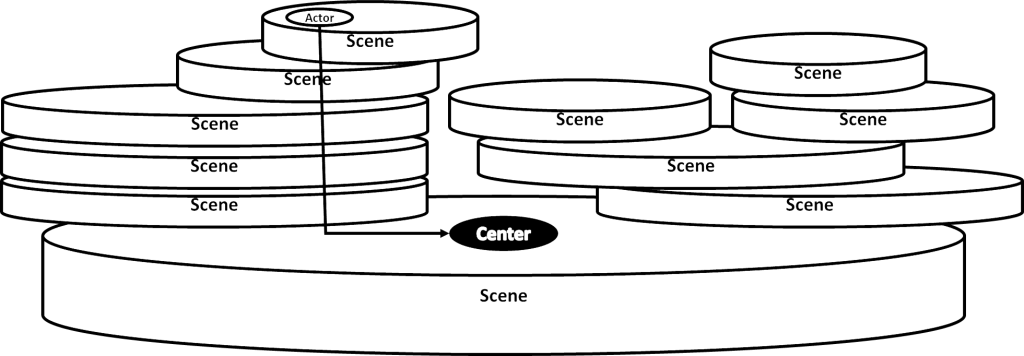
This additionally has the advantage of retaining perspective when one’s attending to a higher scene – which I called “tributary” scenes (and centers) in my book – ensuring that the imperatives issued and inquired into are actually in the interest the more deeply embedded imperatives that the tributary scene(s) is ostensibly meant to elaborate upon. For example, if one’s at a project group in a hospital, it helps retain the perspective of e.g. how to best keep people alive and them healthy, when one’s in a scene which object of attention is the food being served.
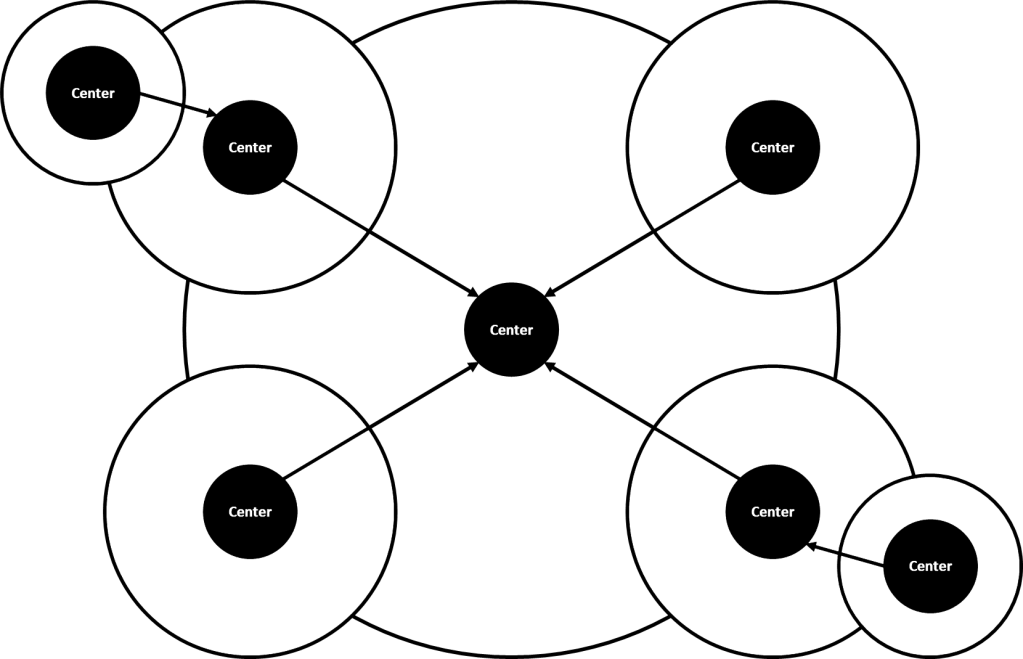
Though that begs the question: How do you assess which scenic stack to commit to, to undertake one’s quest of virtue2? The answer I gave in my book was to become acquainted with the various scenic stacks that one’s social order is comprised of; and then reason which centers are deeply embedded enough that they’re unlikely to close in one’s lifetime, and you deem you’re capable of servicing. Continuing with the previous example, the center one located may comprise an object of attention of something like “the wellbeing of the populace” – however what constitutes as “wellbeing” and how to service it can entail a multitude of things. It could be the physical healthcare as previously suggested; it could likewise be the mental health; it can be address cultural, spiritual, as well as material issues; etc. To extend it to my own work, I consider what I do to contribute to human wellbeing and flourishing by aiding Stoicism to become a discipline that’s alive again, which in turn will help both existing Stoic practitioners and perhaps extend it into new areas that attracts people from other walks of life than those who’re typically attracted to Stoicism – and even if not, some new theories, concepts, techniques, and advice (and idioms, perhaps) may be conceived that’ll find their way outside of Stoicism3. And secondarily also spread awareness of Generative Anthropology, as it is currently a small niche that I consider holding vast potential (as I wish my work to demonstrate), and thus the world would be served well to pay attention to.
Aesthetics offers a pathway of ascertaining of which center and scenic stack to commit to. For the majority of people it’ll come naturally, locating somewhere they “belong” which could be interpreted as an aesthetic reflection that resonates with them, compelling their dedication. The Stoic may deliberately seek out parts of the social order with the appropriate or compelling aesthetic reflection, or set up shop in areas that hold the potential for the aesthetic reflection they envision – whether that entails nudging existing scenes or establishing new ones.
Regardless, per Generative Anthropology, and as I expounded in my last article, aesthetics is the first mover that compels us to action, preceding ethics and morality, but emerges in the collective context and relation between object, actors, and the signs that represent them. Hence it shapes and arranges the scene, informing the moral symmetry that emerges, the ethic that arises therefrom, ultimately reflecting what virtue will be, in the end. So that begs the question, how may we situate the classical Stoic notion of the “passions”?
Moved by passion
Contemporarily, the word “passion” is used to describe that which deeply compels us to action, and the learned Stoic knows that it shouldn’t be confused with the Classical notion of the word. In Classical Stoic theory, reason and passion are two sides of the same coin: Passion is an excessive impulse followed from faulty judgment, though they require voluntary acceptance. The ancients considered passions excessive impulses that hadn’t been tempered by reason before they were assented to.
Circling back to the article I wrote on the psyche, we can surmise that the ancient Stoics indirectly came to the same conclusion I did in that article, that passion is a consequence of system 24. These are impulses that have been past our conscious faculty for deliberation – i.e. weren’t just instinctual or reflexive – and yet weren’t “reasoned”. As I also mention in that article, in my book I identified “reason” (i.e. logos) as a post-ritual concept that one applies to oneself – ideally every time one makes a judgment. It’s deliberately postponing making a judgment and coming to a conclusion, opening a space for additional information to present itself, to assess and evaluate the various ostensives and imperatives in play. For example, when observing something, few will consider it well-reasoned if one immediately makes a judgment based on the first stimuli that presented itself; rather, providing a space for additional stimuli to present themselves, providing a more complete comprehension of the situation, is more likely to be regarded as well-reasoned. Occasionally circumstances may dictate that there’s little time for clarification, and then one must just make a judgment with the time and information available, reason it out as best as one can (which involves trying to model out the missing pieces to the puzzle, where prior knowledge and experience that bears similarity can help fill in the blanks). And the studied Stoic ought to recognize this performative effect in the famous “Stoic Pause”.
What distinguishes passions from reasoned judgment, and the actions those judgements precipitates, is whether we still keep sight of the center(s) we’re attending to. Reasoned judgments and actions will reflect what the center is telling us and the imperatives its issuing; conversely, unreasoned judgments and actions will not have listened to the center first, even if the judgements and actions are ostensibly in the service of the center. As a hyperbolic example, say someone kills some animals – perhaps wild, perhaps domesticated; perhaps private, perhaps public – one may come to the judgment that the person must be killed in turn; however perhaps the shared center, i.e. the scene where other social actors who also have a stake in those animals, deems that the man be brought to collective justice (i.e. trial, judgment, punishment) rather than reflexive reciprocation, then one’s hasty judgment and actions may end up harming the center even more, despite intending the opposite.
Thence the understanding of passion I arrived at in my book is essentially reaffirmed as “that which causes you to lose attention to the center(s one is committed to)” – with the understanding that passions are the internal cause to external stimuli that results in faulty judgment and actions. Continuing with the previous example, it might superficially make sense not continuing to pay attention to the dead animals, because they’re dead after all; however as really anything we pay attention to generates a center of attention, and – particularly when there’s other actors donating their attention to the center – checking in with the center first will virtually always be prudent. And even if it was wholly just one’s own, then there are still other centers that may yet be salient; e.g. think back on the scenic stack – if those animals were in some way relevant to “human wellbeing”, then going around murdering people (even if they’re guilty) as a vigilante may be a cause of fear in the community, and not serving the purpose of wellbeing (and particularly for the question of violence, there’s always the risk of escalating mimetic violence).
Revising terms
Just as the studied Stoic is aware that the ancient use of passion doesn’t quite translate to the modern usage of the word, they’ll likewise be aware that the Grecians of old didn’t have a separate word for what we today refer to as “emotions”, originating during the renaissance. Likewise, we have another renaissance word that exists in the modern vocabulary, namely “pathology”. Pathology is a Latinized composite word of the Greek “pathos” and “logia”, whereas passion is more directly just a Latinization of version of “pathos” – hence passion etymologically directly refers to either experiencing, enduring, or suffering, whereas pathology is the study of the former.
Consequently, there’s an open question of whether some of these concepts ought to be at least relabeled, if not reworked. On one hand, how Stoics use the word “passion” is etymologically correct; yet in contemporary vernacular it’s confusing, and adapting it to present circumstances where passion has (literally) been romanticized by romantic philosophers, poets, authors, and artists from eras past, to become this positive and revered concept it is today. The term pathology could very well be used, as it’s frequently used in reference to mental issues, yet it’s intended use is in reference to physical illnesses.
Though I think more importantly, the notion of emotions ought to be situated within Stoic theory, as whether Stoicism acknowledges or dismisses feelings – and emotions is often a debated issue, whether a Stoic ought to be emotionless or not. Generative Anthropology distinguishes between the animal instinctual side, and the human mimetic side, of humans – meaning that humans consist of two categorically separate, yet interdependent, “layers”, that interact with each other on the regular. E.g. mimetic desires originate within what Eric Gans classifies as “appetites”, i.e. the inherited animal urges like hunger, sleepiness, mating, etc. – these appetites combine with mimesis to form our desires (and resentments). Similarly, we’ve inherited animal feelings – like fear – that when combined with mimesis become our emotions – e.g. fear may turn into anxiety when mixed with mimesis, as a sort of fear of the (potential) future.

In my book I suggest a tentative differentiation of emotions as “obligations to the center which causes one to lose sight of ostensives or imperatives” because emotions are mimetically extended feelings that pertains to the center; e.g. anxiety could originate from the fear of whether we’re servicing a given center well enough, and embarrassment may stem from not having lived up to the expectations of the center. But this understanding is only in the sense of how emotions get in the way of virtue, as a passion (or pathology). The previous understanding of passion as anything that makes us lose our attention obviously also captures the above.
Once again we reaffirm the founding idiom of Stoicism and remind ourselves that the Stoics principal end is virtue, and that the idiom stipulates one ought to always be virtuous. Hence if feelings and emotions can get in the way of being virtuous, just as appetites and desires can, then it must be dealt with. Does that mean being completely emotionless? Not quite!
Feelings and emotions must never be an obstacle to being virtuous, meaning that the Stoic sage must be able to keep them under control at all times. From there however, feelings and emotions are completely fine, and may actually assist in one’s pursuit of virtue – because they are themselves sources of information, to be analyzed, evaluated, judged, and acted upon. For example, if a dangerous situation arises, fear is an appropriate source of information that suggests how to act – e.g. “with caution”; however, the skilled Stoic must still be able to overrule that fear and act virtuously as the situation dictates, e.g. helping others escape or engage in mitigative measures – e.g. if a caretaker of children faces a dangerous situation, we wouldn’t begrudge them for feeling fear, but would if that caused them to abandon said children.
However, what’s speaks even more directly to Stoics not being emotionless, is that the collective intentionality of the center is constituted by the shared joint attention of all the actors dedicating their attention to the same central object. Which means that virtue is constituted by the collective attention that’s donated to the center, even one’s own. Hence the feelings and emotions one’s experiencing ought to also inform the center, as should all the other actors, thus informing not what oneself should do, but everyone else as well5. Thus acknowledging one’s own feelings and emotions is actually a public service that does everyone a favor – the Stoic just cannot let them interfere with whatever the outcome of the collective donation and subsequent imperatives issued (e.g. everyone may donate their feelings and emotions that “this is scary”, and thus the fear is collectively felt, yet may still need to face it to remedy the situation).
Hence, I’d say it’s a tossup between whether to continue using the term “passion” or adopt the term “pathology”. However, I do regard differentiating feelings and emotions out separately as a real performative benefit, which ought to be continued. This would necessitate that distinguish between feelings and emotions that becomes passions or pathologies (by making oneself lose ones attention), from feelings and emotions as a whole. I even consider it possible for a Stoic to be a highly emotional person that deeply senses what he himself, as well as – or, perhaps especially – what others, feel. The important part is that they’re able to keep them in abeyance to the extent needed, so that they can still apply reason and listen to the center(s) to act with virtue.
Final thoughts
Though it’s impossible to preordain what compels and motivates, as mimetic beings it’s guaranteed that it originates within mimesis in some form6. That’s why it’s so important to cultivate and sculpt the mimetic aspect of one’s psyche as well as explore and familiarize oneself with the scenic stacks of the social order one’s going to be acting within. As previously ascertained, both aesthetics, morality, ethics, and ultimately virtue, emerge within the mimetic (as anything human); thus mimesis becomes one of the most central subjects and areas of inquiry in this Originary conception of Stoicism, including compulsion. To be sure, there’s a lot of path dependency and random chance in terms of what one gets exposed to – and the earlier it impresses on the psyche, the greater effect it’ll have on shaping our lives, influencing what motivates and compels us. Thence it’s all the more important that the Stoic is very deliberate with not only what he exposes himself to, but perhaps even more so what mimesis he expresses and impresses upon others – it may even be one of the one of the most important and demanding duties of the Stoic scholar, to construct spaces (scenes) with just the right kind of mimesis to impress upon others so that the nurturing environment provides the most conducive preconditions and premise to turning them out the best they can.
Not that it could be any different, as scenic beings.
I.e. as ”memes” in the original sense as “cultural gene” as conceptualized by Richard Dawkins.
As adapted from Daniel Kahneman’s ”Dual Theory of Mind”.
This also obviates the classical critique of Stoicism, that if they have no passions or emotions of their own, all they can do is being servants to those of others.
Or it could originate from the animal instinctual, but would inevitably be mimetically extended regardless.